

Message delivered by the Chairman of the Commission for the Corruption Prevention Forum
- Thu, 6 December 2018
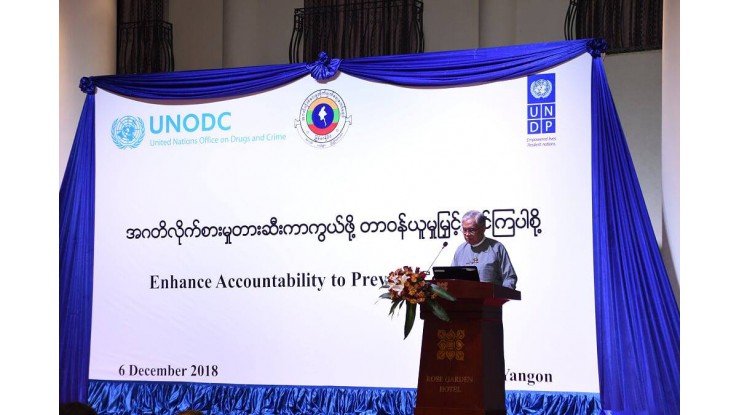
6-12-2018
1. Introduction
2. At the outset, I acknowledge the valid criticism regarding the pervasive issue of corruption in Myanmar. Corruption has deeply penetrated our nation's institutions, affecting public and private entities, mass organizations, governmental departments, legal systems, disciplines, and traditions. Unfortunately, corruption has become intertwined with our social fabric, economy, employment opportunities, and cultural norms, making it seem almost inevitable and widely accepted. Its presence is ubiquitous, and many believe that combating corruption is an insurmountable task. For those who have long been entangled in corruption, the prospects of change appear bleak, and the concepts of prevention and awareness seem distant and elusive. In countries facing institutional illnesses, certain leadership figures exhibit two distinct mentalities. One perspective acknowledges corruption within subordinate departments, considering such actions abhorrent as they undermine staff capabilities. Simultaneously, a contradictory viewpoint tolerates and rationalizes personal gains if they are deemed insignificant in their implications.
3. So, as an initial step, the Commission is targeting the big fish. Simultaneously, we are also addressing corruption at lower levels to the extent possible. Genuine anti-corruption efforts often involve uncomfortable phases for any nation. To safeguard our citizens' long-term interests and uphold our nation's honor, we must consistently implement our Anti-Corruption Strategy. Demonstrable actions are essential to shift public expectations. This transformative shift, referred to as 'momentum,' revolves around the concept of 'enhanced accountability'—a central theme of today's forum.
4. The responsibility to foster this change does not rest solely with the government; public institutions and private enterprises also play a crucial role. Every citizen must bear a share of this responsibility by recognizing the breeding grounds of corruption and understanding the systems it exploits. We must be aware of how corrupt practices distort the services that the state should provide. Officials across various sectors must comprehend the mechanism of corruption at all levels of governance, including local administration, judicial processes, and law enforcement. Similarly, businesses must identify corrupt practices within procurement, construction, rentals, and sales processes. Therefore, a collective acceptance of individual responsibilities, combined with a concentrated effort to enhance leadership accountability, has the potential to significantly reduce corruption. This forms the core of our strategy for combating corruption.
5. How can accountability be enhanced? The strategy to combat systemic corruption, which pervades the nation, must include individual accountability for eradicating corruption within one's workplace. This accountability integration occurs in at least four stages. The first step involves continuous assessment and evaluation of your department's performance in terms of corruption prevention, followed by taking ownership of making improvements. Those who make improvements will be acknowledged and rewarded, while those who do not may face consequences. In this context, emphasizing the need to change the operating systems, methods, rules, and regulations of corrupt departments is essential for effective on the management of reducing the number of persons who may be prosecuted.
6. The second step is to listen to the voices of the public sector, corporate sector, media, and civil society. Establish a system for receiving complaints from individuals who have experienced unfair treatment, and regularly evaluate corruption within the agency. Additionally, consider advice from others on combating corruption.
7. The third step in integrating accountability involves inviting an external organization to review, monitor, and assess the department's performance. Seeking third-party verification and assessment by a public entity that provides services to the general public is not an embarrassing situation; rather, it is a source of pride and a firm commitment to accountability and responsibility.
8. The fourth step involves recognizing that corruption is a calculated criminal and an economic offense, setting it apart from other crimes driven by anger. To bring about comprehensive change, strong leadership within the institution is necessary. The refusal to accept bribes is more important than the value of the gift, regardless of the possibility of avoiding prosecution. Those who do not escape prosecution are taking risks based on the penalties they will face. This is crucial because individuals with higher incomes often possess greater power and a higher potential for corruption. To effectively prevent corruption, leaders must ensure that no one escapes accountability for their corrupt actions. Therefore, it is essential to have early access to information, take prompt preventative action upon receiving reports, and reward or penalize individuals based on their performance.
9. As mentioned earlier, corruption, which has become systemic throughout the country, has led to the corruption of institutions. What is happening in workplaces is that corruption is becoming organized. To promote favoritism, individuals are designated as key players who provide benefits, contribute to their work, recruit new personnel, and engage in hierarchical sharing and mutual protection. There is a pressure system that encourages corruption. No country in the world permits corruption or solicitation by law. However, prosecuting those who engage in organized corruption alone is impossible, and we cannot expect them to voluntarily cease their activities. Therefore, it is crucial that we address organized corruption by creating a balance. This cannot be achieved by the Commission alone. I strongly advocate for the commitment of public organizations, including government departments, private businesses, experts, all media outlets, and civil society organizations to collectively form an integrity pact and unite against corruption. This aligns with the current international anti-corruption motto, 'United Against Corruption.'
10. In reality, corrupt individuals cannot withstand the power of transparency. Wherever possible, we must champion transparency and fairness and resist systemic corruption. No one can remain neutral when confronted with corruption; closing our eyes aligns us with darkness. It is crucial to keep our eyes open and empower public institutions, including government departments. Through vigilance and open eyes, we demonstrate our responsibility.
11. My current presentations focus on the 'accountability' aspect of the ongoing implementation process of the Commission under the Anti-Corruption Strategy Plan. While this strategy was developed in coordination with domestic and foreign experts, based on discussions and presentations by academic representatives from various fields during the Ethics Symposium held last January, it is not considered entirely flawless. Therefore, the commission actively seeks more valuable ideas with transparency. In conclusion, I want to highlight that experts, representatives from various departments, the private business sector, and various organizations attending this forum have freely offered criticisms and insights in response to the request for supplementary advice.


